
Note: Speckled Feeder Roaches will not be available until further notice to allow us to build up numbers.

Speckled Feeder Roaches

Brian, has been working hard in the insect breeding division to come up with the perfect feeder roach for your insectivorous herp


The Herp Shop decided to diverge from cricket breeding to Speckled Feeder Roach (Nauphoeta cinerea.) breeding. Following over 6 months of fine-tuning the production and grading methods, numbers are now available to be able to supply these on a regular basis.


Speckled Feeder Roaches:
Easier to keep & breed.
Live longer
Just as acceptable to reptiles & amphibians as other foods
Perfect for Dragons, Skinks & Monitors
Unlike crickets, they almost 'thrive on neglect'

 
Approximate Size
average weight per 100
Price
25 mm
50 grams
$6.60 per 50 grams
20 mm
20 grams
$4.40 per 20 grams
15 mm
10 grams
$5.50 per 10 grams
10 mm
5 grams

$3.30 per 5 grams

Note: Speckled Feeder Roaches will not be available until further notice to allow us to build up numbers.

Delivery: Sent anywhere in Australia by Australia Post (Express Post). Mailing out days are usually at the beginning of each week, usually Tuesday, Orders need to be in by midday Saturday. Prices do not include postage. Express Post/Pack up to 500gm is $10.00. (ie Box (280g + up to 220g of SFR's) Postage for larger orders dependent on weight and destination. Call the Herp Shop to work out the best deal.
Orders are shipped in our specially constructed Speckled Feeder Roach shipping boxes or postal tubes. (We find the tubes better for smaller sizes/quantities.) The boxes have been engineered to ensure that our Speckled Feeder Roaches arrive at your door in prime condition. They are glued and stapled to ensure there are no escapees and metal fly screen ensures adequate ventilation.


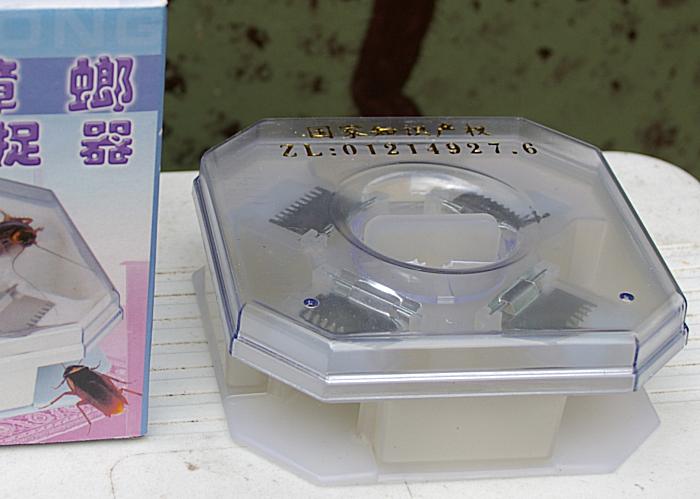
Recover all your escapees. Place just a small amount of Roach food in the center compartment and watch the roaches march in. (Click the image above and take a closer look.) The entry of the roach into the trap is heralded by the feint tinkle of the aluminuim fingers of this amazing trap.

Just $15.00 at the Herp Shop.


*** Now back in stock ***

Fluon ADI

Speckled Feeder Roaches do like walking up plastic & glass. To control any problem of escaping over open containers we have a product that can be painted on around the inside of the upper section of any holding container. This product really works and is far preferable to alternatives. A single container of this paint will last the average user a life time. (The breeding tubs, featured in the pictures below, use a line of this paint to help contain the SFR's)

$30.00 per 250ml bottle


Give the Speckled Feeder Roaches a go. Talk to others that have used them and you won't look back. We can supply the quantities you need in the sizes you require.

A tub containing Adult Speckled Feeder Roaches. Note how they stay in the tub and do not try to climb past the layer of Fluon.
We keep good quantities of all sizes.

What is the SPECKLED FEEDER ROACH ?

Nauphoeta cinerea

This large roach, growing to almost 30mm in length, has been used as a reptile/amphibian food item for several years in Australia.

One common name is the Lobster Cockroach but as another species carries this same common name with a different scientific name, it is perhaps wise to avoid confusion and not refer to N. cinerea as the Lobster Cockroach. Other common names used are the Madeira, Cinereous, Tampa, Speckled and finally 'Woodie". As the Australian common name, "Woodie" is inaccurate and we have decided to adopt one of the other accepted names "Speckled" and add a slight slant to it. The "Speckled Feeder Roach" which will probably be abbreviated to "Feeder Roach". We will all know what we are talking about.

This species has a world-wide distribution and was originally named Blatta cinerea in 1789 from specimens taken in Mauritius and was not given its present name Nauphoeta cinerea until 1922.

It is a tropical domiciliary cockroach of the New and Old Worlds, occurring in Cuba, Hispaniola, Mexico, Brazil and the Galapagos Islands. In the East, it is widely distributed in the Philippines, Sumatra and Singapore and occurs in Australia, New Caledonia and the Hawaiian Islands. The East African records extend from Egypt through the Sudan to eastern Tanganyika (now Tanzania), the Transvaal and Natal. It also occurs in Madagascar and Mauritius. Studies indicate that its native home is East Africa. Movement to other countries would have been no doubt by trading vessels and galleons as early as the sixteenth and seventeenth centuries. Colonies were identified in Florida, U.S.A in 1952 and were found established in an area of Tampa where there were mills producing animal feeds. Hence the common name Tampa Cockroach.

It was first recorded in Australia in 1918 where it is regarded as a 'semi-domestic' species, as it is found in out-houses and stores rather than in dwellings.

Biology:

This is a false ovoviviparous species in which the oothecae contain 26 - 40 eggs. The nymphs hatch as the female extrudes the ootheca from the brood sac; they shed their embryonic membrane as they hatch and eat both it and the ootheca. Newly hatched nymphs crawl beneath the female, even under her wings, and remain there for about an hour after hatching. In the laboratory the number of nymphs hatching from oothecae increases from an average of 20 from the first egg case to about 30 from the third and decreases thereafter. Female nymphs take longer to mature than males.

Biology of Nauphoeta cinerea based on Laboratory Data (Averages) at 30°C:

Minimum period between moult to adult and copulation
6 days in both sexes
Interval between moult to adult and production of first ootheca
13 days
Interval between moult to adult and hatch of first brood
44 days
Interval between hatch of successive broods
1st - 2nd 40 days
7th - 8th 99 days
Average broods per female
6
Incubation period in brood sac
36 days
Eggs per ootheca
33
Hatched eggs per ootheca
31
Percentage of hatched insects that matured
99%
Number of moults
7 - 8
Period of nymphal development
.

(i) in isolation:
males (7 moults)
females (8 moults)


73 days
94 days

(ii) in groups:
males
females


72 days
85 days
Adult life span
.
males
365 days
females
344 days


Rep-Cal® (Aust) - Division of 'THE HERP SHOP'

The HERP SHOP is the importer and Australasian distributor of Rep-Cal products. 

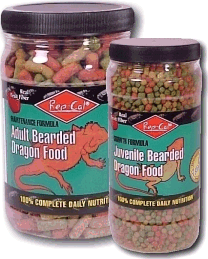
BEARDED DRAGON FOOD

Another quality product produced in the U.S.A by Rep-Cal Research Labs.

Although marketed in the U.S.A as Bearded Dragon food (because of the popularity of these lizards overseas) it is also suitable for most of our other dragons and most certainly skinks.

It comes in pellet form and is available in both juvenile and adult formula.

Rep-Cal Bearded Dragon Food is veterinarian formulated to ensure proper growth and health by providing complete and balanced nutrition.

Rep-Cal Bearded Dragon Food is fortified with optimal levels of vitamins and minerals like calcium and vitamin D3 so no other food supplements are required. Because Bearded Dragons are sometimes wary of new foods, make all food changes gradually and monitor your lizard's weight, condition, and food intake.

Feeding Instructions:

** Moisten food in water or fruit juice.

** Offer slightly more food than your lizard will eat in an 8 hour period.

** Fresh greens, mealworms and crickets may be added as treats.

** Provide adequate fresh water daily.

 When switching to Rep-Cal Bearded Dragon Food from another diet, allow several days for the transition. Mix increasing amounts of Rep-Cal Bearded Dragon Food with less of the previous food until your lizard is only eating the Rep-Cal food.


Juvenile Bearded Dragon Food - Growth formula. 170g net

$15.00 each

Adult Bearded Dragon Food - Maintenance formula. 226g net


$19.00 each


CRICKET FOOD

Repcal Cricket Food is formulated to nutritionally enhance invertebrate feed for reptiles. It is a veterinarian recommended food containing a tasty blend of high quality ingredients. Suitable for both Speckled Feeder Roaches and Crickets this food will maintain your feeder insects in prime condition for your insectivorous herp!

Rep-Cal Cricket Food 212g net

$15.00

Rodent are now available from the herp shop and are on our new Rodents page...